
Why fall is the deciding season here
Winter does not create most roof problems in North Central Washington. It finds them. A cracked pipe boot, a split sealant joint, a valley packed with needles, a lifted shingle from an August windstorm: none of those leak much during a dry fall. Then the first sustained freeze arrives and every one of them becomes an entry point.
The reason is meltwater with nowhere to go. Snow sits on the roof, the surface warms during a sunny afternoon or from heat escaping the attic, water runs, and it meets cold air at the eaves and on shaded planes. It refreezes there. The next cycle of meltwater hits that ice and goes sideways and backward instead of down, finding every gap the summer left behind.
Fix the gaps in October and the same winter is uneventful. That is the entire argument for a fall inspection, and it is why we are busiest with maintenance visits in the weeks before the weather turns.
What a fall inspection actually covers
We start with the field of the roof: shingle condition, granule loss, curling, cracking, lifted tabs, or on metal, panel alignment, fastener condition, and any oil canning or movement that suggests a fastening problem.
Then the details, which is where the real work is. Every penetration gets checked: pipe boots for cracked collars, vents for loose fastening and failed sealant, skylights for perished gaskets and flashing gaps. Chimney flashing gets looked at closely, because step flashing and counterflashing that was caulked instead of formed is the most common leak source we find on older homes.
Valleys get cleared and inspected. Debris in a valley is not just cosmetic, it dams the water channel and holds moisture against the surface all winter. Sidewall and headwall transitions get examined, since wind-driven rain and backing meltwater both attack those first.
We check the eaves and the drip edge, because that is where ice dams do their damage, and we confirm whether ice and water membrane was installed at the eaves and valleys. On higher-elevation properties that membrane is not a nicety.
Gutters and downspouts get attention next. A gutter full of needles freezes solid, holds a block of ice against the fascia and the roof edge, and adds weight where you least want it. Downspouts that discharge onto a walkway create their own ice problem.
Finally, the attic. We look for daylight, staining, damp insulation, frost on the sheathing, and whether intake and exhaust ventilation are actually balanced. A warm attic is the engine behind ice damming, so ventilation gets treated as a roof issue, not a separate one.
Ice dams and snow load in North Central Washington
Snow load varies enormously across our service area. A roof in East Wenatchee and a roof in Leavenworth face completely different winters, and higher-elevation properties see accumulation measured in feet that sits for weeks. Sustained weight matters structurally, especially on lower pitches, on long unsupported spans, and where drifting piles snow deeper on one side than the other.
Ice damming is the more common damage source. The sequence is always the same: attic heat or sun warms the upper roof, meltwater runs down, it reaches the overhang where there is no warm attic beneath it, and it freezes. That ridge grows, water pools behind it, and pooled water gets under shingles and behind flashing in a way running water never would. Ceiling stains in January are usually this.
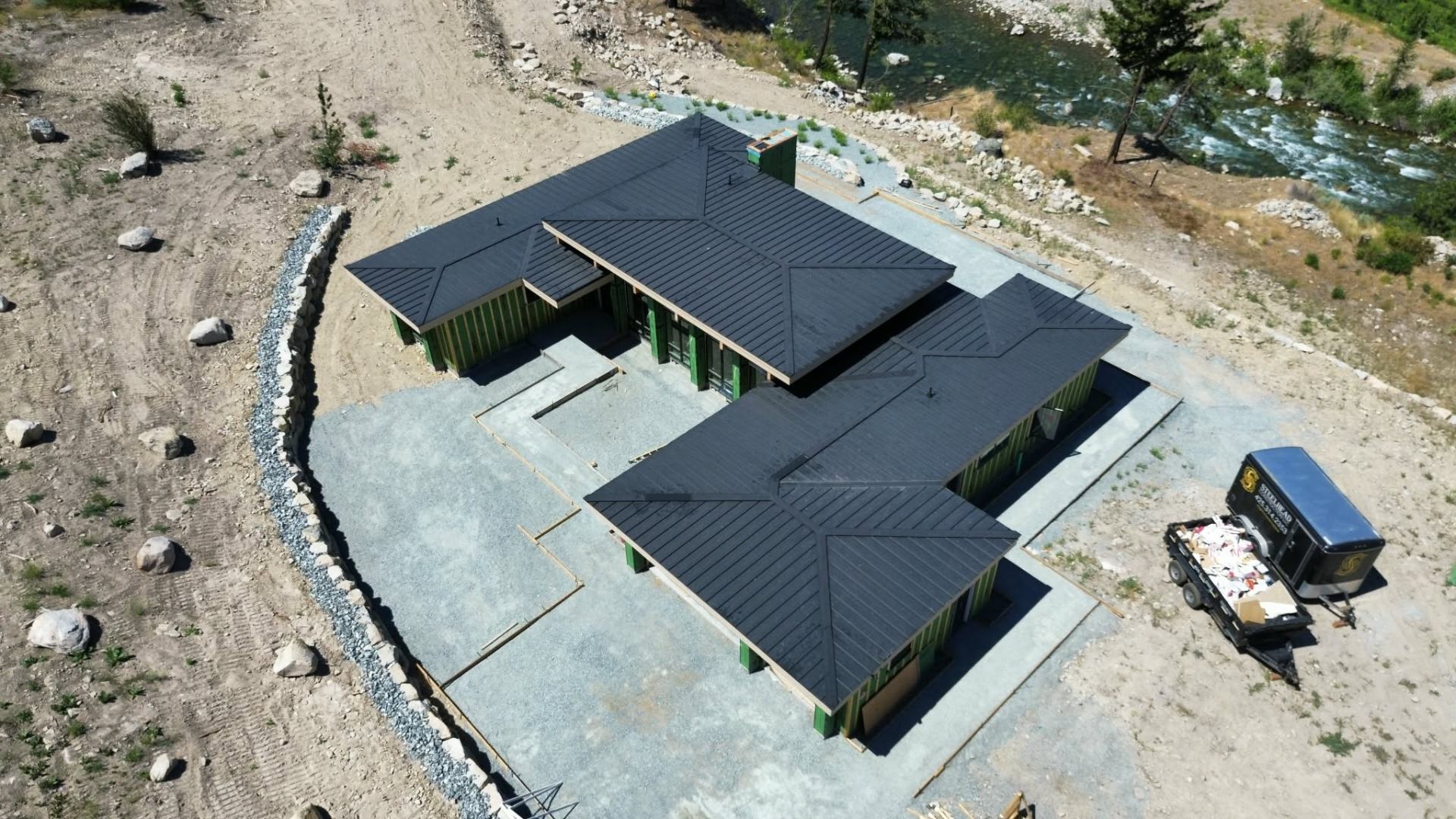
Metal roofs reduce the problem by shedding snow before it can cycle repeatedly, which is a large part of why they are popular at elevation. They do not eliminate it, which is why eave protection and ventilation still matter, and why snow retention needs to be planned over anything you walk or park under.
What you can safely check from the ground
Walk the perimeter of the house with binoculars or your phone camera zoomed in. Look for missing, lifted, or curling shingles, any dark patches that look different from the surrounding field, and anything visibly out of line on a metal roof.
Look at the gutters. Heavy granule accumulation in them is a real signal that the shingles are wearing out. Sagging gutters, or gutters that overflowed and left stains down the fascia, tell you drainage is already failing.
Check the flashing lines around the chimney and where roof planes meet walls, as far as you can see them. Rust, gaps, and visible caulk beads are all worth a photo.
Inside, look at the ceilings under the roof and at the attic if you can access it safely. Stains, soft drywall, musty smells, or frost on the underside of the sheathing all mean water is getting somewhere it should not.
What not to do: do not go up on the roof. Steep valley pitches, morning frost, and loose granules are how people get hurt, and none of the checks worth doing require you to be up there. Send us the photos instead.
Getting it handled before the snow
Our free inspection includes the whole list above, with photographs of anything that matters, and a written explanation of what needs attention now versus what can reasonably wait. If the roof is in good shape, we tell you that and you head into winter knowing it.
Small repairs in October are straightforward work. The same repairs in January involve snow removal, cold-weather material limits, and an active leak inside your house. Licensed and insured in Washington, registration EMPIRRS793LC.
Helpful reading: our maintenance program handles this checklist on a schedule so you are not the one remembering it every fall.
Roof maintenance services